4. Convening cycle
- 4.1. Planning together
- 4.2. Communication strategy and output
- 4.3. Roles involved in convening cycle
- 4.4 Convening timeline
- 4.5 Convening platforms, tools and repository
- 4.6. Budget and finance
- 4.6.1. Budget forecast
- 4.6.2. Travel expense, per diem and reimbursement
- 4.6.3. Resource persons’ subcontracts and agreements
- 4.6.4. Post-convening finance reconciliation
- 4.7. Location and venue selection
- 4.7.1. Location comparison
- 4.7.2. Venue assessment, cost comparison and procurement process
- 4.7.3. Accommodation
- 4.8. Convening risk assessment
- 4.9. Participants’ information and communication
- 4.9.1. Identification, selection and confirmation
- 4.9.2. Applications and expression of interest to participate
- 4.9.3. Logistics registration survey
- 4.9.4. Information and communication
- 4.10. Visa
- 4.10.1. APC-hosted or co-hosted convenings
- 4.10.2. APC delegations or APC satellite events to external convenings
- 4.10.3. Types of visa
- 4.10.4. Visa support systems
- 4.10.5. Information and supporting documentation for visa application
- 4.10.6. Host information
- 4.10.7. Visa support documents
- 4.11. International and local travel
- 4.11.1. Flight bookings
- 4.11.2. Trusted travel agents
- 4.11.3. Travel agency ordering numbers sheet
- 4.11.4. Bookings made by authorised staff
- 4.11.5. Bookings made by participants
- 4.11.6. Local travel in origin country
- 4.11.7. Ground transportation in destination country
- 4.11.8. Transportation schedule
- 4.12. Safety, well-being and care
- 4.13. Monitoring, evaluation and learning (MEL)
4.1. Planning together
A convening is the result of teamwork that engages not only the hosting programme/team but also most of the Operations and Organisational development teams: People, Systems and Operations, Finance, Tech, MEL, as well as NetDev, Comms and Resource Mobilisation (ResMob).
With this in mind it is critical to have clear processes, workflows and procedures that can accompany and facilitate the realisation of collective efforts.
The manual intends to apply an organic approach to various elements that make up a successful convening, and making visible the interdependencies that exist between the various tasks that influence the timeline. This is critical to ensure that the most discriminated participants (see visa application) have enough time to be supported for travel and can participate meaningfully, and that all contracted services as well resource persons have the adequate administrative and content information.
4.1.1. Convening implementation
This manual will address the implementation cycle of an in-person convening in detail.
For online and hybrid convenings please review particularly the relevant sections from APC guidelines on planning and designing online events as well as APC hybrid events guide 101.
Developing a programme and a schedule
For APC-led or co-led convenings, the point of contact is responsible for the concept note addressing the purpose of the convening and its key elements. They select the external facilitators or other resource persons supported by the Ops manager on issues concerning subcontracts and procurements.
They will introduce the Ops core team or APC Ops programme staff to consultants as well as partners and participants, share the registration survey link to all participants or inform the Ops core team via logistics[@]apc[.]org or the Ops programme staff of the need to reach out to facilitators, other invitees, local partners and so on.
It is important to ensure continuous communication between the person or team focusing on developing the convening programme and the schedule and the operations staff responsible for all logistics and other administrative tasks. This will ensure timely response and the ability to verify the correspondence between what is desired and what is available and possible within the time-frame and the allocated resources.
For APC-wide convenings, the point of contact leads the development of the APC overall strategy and session applications.
To ensure smooth and continuous communication between the point of contact and the operations staff responsible for all logistics and other administrative tasks, it is advised that the point of contact schedule and hold at least three coordination meetings:
- At the start to agree on and fine tune timeline planning (as soon as the chart of roles is completed)
- Half way into the agreed timeline for adjustments and monitoring
- One / two weeks before the event for final agreements
4.2. Communication strategy and output
4.2.1. Planning – producing – disseminating
The APC Communications team’s role for APC-wide convenings and APC-led or co-led convenings when requested is to co-lead and support the communication strategy, support with exhibitions, booth, materials and any other Comms-related activity or output. They are part of the convening coordination team’s automated task management (currently on Redmine) and also of the dedicated Mattermost (MM) channel.
The Comms team reviews and contributes to risk assessment and mitigation measures and contributes to the APC safety guidelines session that addresses the dedicated measures. They look after consent for content sharing, privacy concerns, and follow best practices in protecting sensitive information.
4.2.2. Booth at APC-wide convenings
Convenings like RightsCon, the IGF, FIFAfrica and the Global Gathering have a village/fair set up that allows organisations to set up booths or stalls to showcase their work. APC uses booth spaces for strategic purposes such as:
The booth is a key space in organising operations before, during and after an APC-wide convening and in designing the overall strategy. It is to be managed on site by dedicated persons looking after operations throughout the cycle. And only they should have the responsibility of maintaining internal primary schedule and booth roster.
Booth roster is used to seek and volunteer to take turns at being present at the booth with slots so that everyone has an opportunity to use the space for dedicated activities as well as the responsibility to take care of the booth as part of the APC community.
Booth design, activities and schedules are co-managed with Ops core team and Comms team since there are collateral and media and printing requirements, making sure the internal schedule and public schedule are aligned.
Whenever there is an info point or a booth, it is recommended to plan and budget for a dedicated person on site to take care of the booth instead of assuming this task will be done by the on-site logistics person. On-site experience has confirmed that the two roles need to be separated as participating staff members need to prioritise active networking, attending and speaking in sessions, as well as meeting donors and spotting opportunities.
4.3. Roles involved in convening cycle
Roles involved in convening cycle
APC has developed a standard chart of roles template that can be adapted and adjusted according to the specificity of the convening. Once this chart is completed, the Ops core team will add everyone to the event form ticket providing additional space beside the MM convening channel, for direct communication and coordination that can be managed either through Redmine or directly through Thunderbird email client.
The benefit of having a dedicated space only for the convening coordination team is the creation of a thread or virtual loop where all information is available to everyone and decisions and conversations can happen away from the “noise” of the Mattermost channel, as some of the more crowded events can be overwhelming or too dispersive.
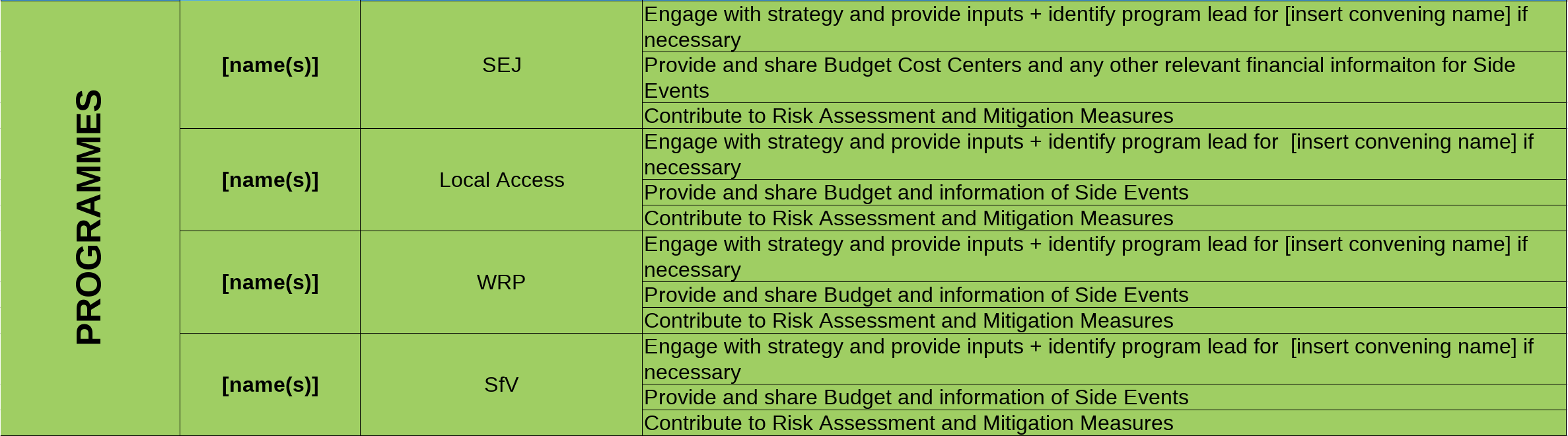
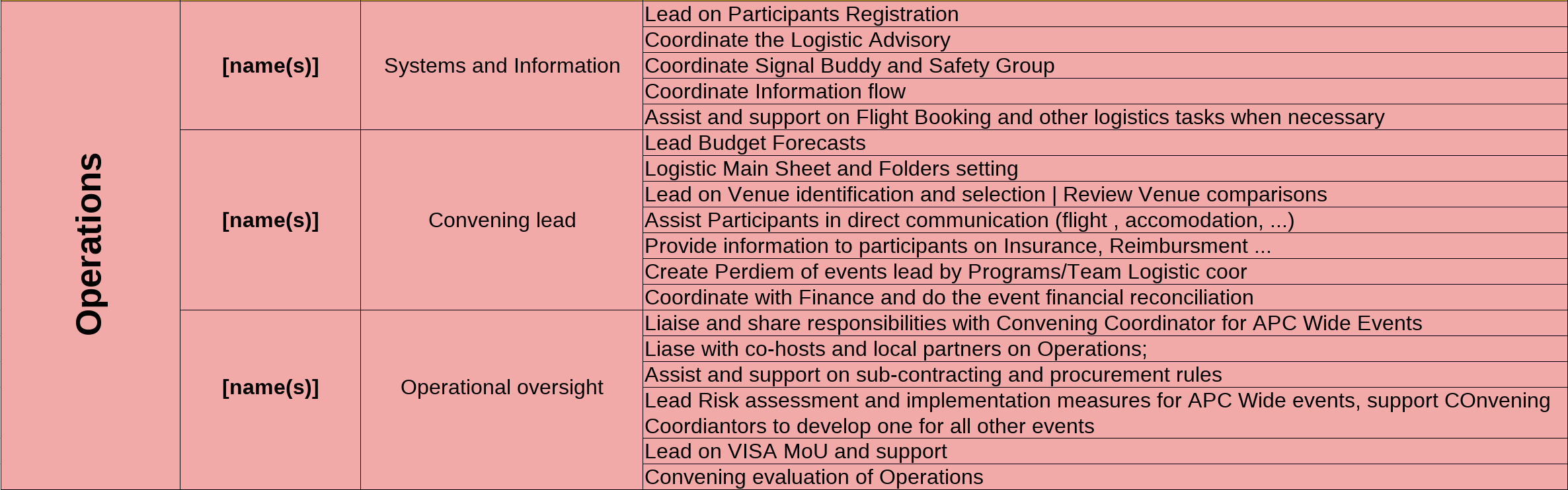
The chart of roles contains two templates, one for planning and the other implementation of the programme schedule and other related tasks. The following table shows all APC teams that can contribute to the planning of the convening and general tasks. The convening point of contact can add or strike out the team involved or the task, adapting them to the nature and the size of the event they are coordinating.



4.4 Convening timeline
Convening timeline
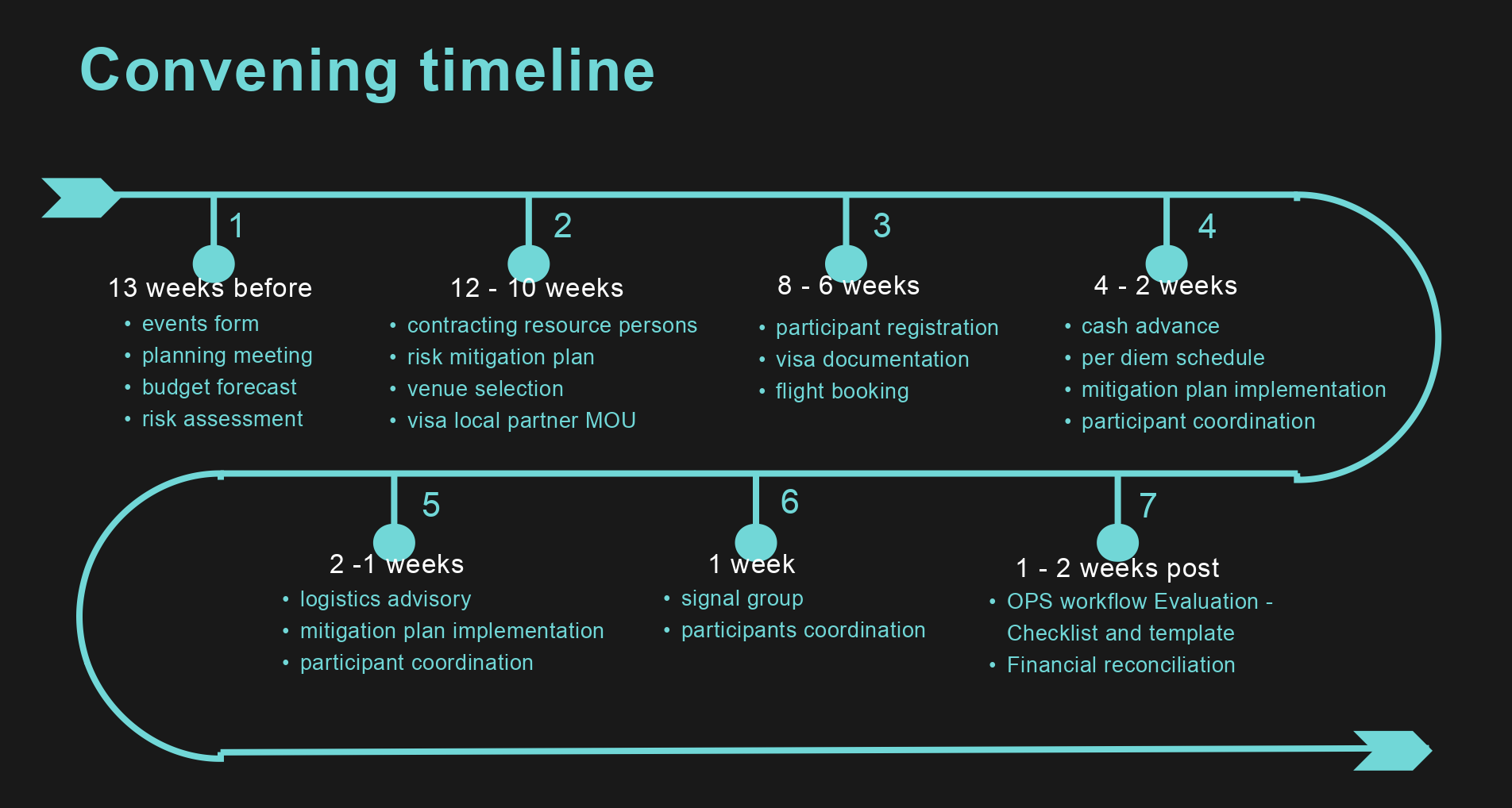
The time required to plan a convening depends on a number of important factors, including but not limited to:
- The number of participants and ways of identifying them
- Visa requirements
- Complexity of the convening (e.g. APC-wide, programme-specific)
- Location
- Co-organisers and partners involved
- Hybrid, on-site, online
- Human and financial resources available
- Sources of funding.
In order to follow up the scheduling and compliance of the convening timeline, there are instruments to facilitate these processes:
Forecast liveboard and convening forms
APC forecast liveboard
To facilitate cross convening monitoring, create a sustainable workflow, the OPS core team have established convening forecast meetings with managers and OPS programme staff twice a year, in January and June, to collect information about possible convenings and create a forecast map.
The systems and information coordinator is responsible for adding, updating and maintaining the liveboard through all information collected during these forecast meetings as well as periodic emails and on-demand consultation for convening plans.
APC convenings scheduling form
The convening point of contact shall begin the planning as soon a convening idea is formalised and proceed by submitting the convening form to record all important details about the event.
It is important the form is filled and shared when dates or locations are still indicative to enable the actual coordination of all involved and provide space for adjustment and consultation in case of clashes and overlaps.
The purpose of submitting the form is to initiate a task ticket that begins the workflow and cycle of cross-team communication and coordination between the organising programme/team, the Ops core team and all other actors involved. Once the convening form is submitted, the Ops core team reviews it in a week’s time. The convening is then recorded on the convening platform and on the APC all convenings calendar.
The convening form creates a circular automated task in the management tool for internal coordination of all member added to it as “viewers”.
APC individual assessment and travel form
In relation to accepted invitations to travel to attend conferences and other kinds of convenings, APC has developed an individual travel form that needs to be filled after the manager concerned approves the participation.
Individual travel to attend convenings: For all individual invitations to travel to events and convenings organised by other entities, APC has developed a specific two-step workflow:
- Assessment of the relevance of the invitation and, if it is okay, a mitigation and contingency plan.
- Individual travel form submission.
The assessment tools are: individual travel assessment checklist and the Mitigation and Contingency Plan; they must be filled and signed before the individual travel form is submitted. This must be shared with the manager concerned and approved before preparing for travel. Staff can also request support from the operations manager to finalise the assessment process.
Small team meetings: A meeting is considered a small team meeting if attended by three to five persons. Such a team’s members can use the individual travel assessment checklist to assess the meeting’s relevance and share it with their manager/supervisor.
It is the responsibility of the small team meeting’s manager/coordinator to assess the risk and share the Mitigation and Contingency Plan with the Ops manager. It is up to the latter to inform and engage the Ops director, who is accountable for the assessment in case of disagreement or assessed risk for the organisation.
The Individual Travel Form is submitted once the individual travel is approved. Instances where the form is applicable include invitation of a staff member to a convening not organised or co-organised by APC; for example, they may be invited to speak, be a participant in a workshop, or moderate a session. The key difference being that these convenings are not organised by APC and the number of APC participants does not warrant group logistics.
In such cases, sometimes the travel is completely sponsored by external organisers, but at other times it is only partially sponsored; hence the individual travel form is used to request specific logistics support from the Ops core team.
In cases of full sponsorship by external organisers and no Ops support is required, it is recommended as a good practice, for reasons of safety, care and transparency, to still submit the individual travel form to include the event in APC Events Calendar and to inform the APC team that there is a staff member travelling.. The Ops core team should be apprised should any kind of emergency support is required.
4.5 Convening platforms, tools and repository
Convening platforms, tools and repository
APC convening coordination and related workflow happen across a set of platform and tools:
- Redmine: Events scheduling form and/or individual travel form
- Mattermost: Event-[dedicated channel]BBB: Real-time meeting dedicated room
- Share2: Event-[dedicated sub-folder]
- APC logistics main repository organised by event [year] (repository for all operations and administrative documentation)
- APC projects or APC event (repository for calls, programme, schedule, strategy)
- Event-dedicated Signal group
- Email and encryption for all formal administrative activities: signature of subcontracts with resource persons, venue contract, MoU and partnership.
- NetSuite: For all financial purchase orders
APC Logistics Mainsheet
The APC Logistics Mainsheet is the instrument where all logistics details related to an event in one place are compiled. The sheet is set up by the convenings lead or OPS programme staff once the convening is confirmed.
The chapters included in the Logistics Mainsheet are:
- Event timeline
- Event budget
- Cost comparison between locations and/or venue options
- Participants’ registrations
- Consolidated participants’ list
- Flight booking details
- Accommodation rooming list
- Participants’ per diem schedule
- Airport shuttles’ arrival and departure schedule (if organised by APC).
The event timeline will be discussed and agreed with the programmes/teams involved in the convening’s planning and will be added to the APC Logistics Mainsheet.
The Ops core team will support the convening point of contact and Ops programme staff throughout the process, from planning to reporting, and in compliance of the convening timeline.
Data management
APC’s convening data are stored in APC own infrastructure and workspaces. Sensitive data such as passport details are stored in protected folder and regularly deleted in line with APC’s data retention policy. Access via public link always has an expiry date.
For a more in-depth understanding of principles, practices and provisions that guide convening data cycle, please refer to APC Data Retention Policy, APC Security Policy, APC Data Policy and APC Privacy Policy.
4.6. Budget and finance
4.6.1. Budget forecast
All convenings require budget. The APC convenings lead will work on a budget forecast, including a detailed list of the most recurrent event expenses such us travel expenses, subsistence costs, venue costs and consultant fees among others. These details will be registered in the APC Logistics Mainsheet for the event.
The APC convening point of contact, along with the programme manager or costs centre approver, is responsible for reviewing and approving the budget for the convening, and for providing cost centre allocations where expenses will be charged.
4.6.2. Travel expense, per diem and reimbursement
APC follows its travel expense policy for overall travel and subsistence costs such as per diem, and reimbursement. It is the convening point of contact’s responsibility to be aware of the policy and liaise with the convenings lead should any other specific need arises based on budget limitations, risk assessment results or other criteria.
Travel expense procurement
APC procurement policy usually requires three or more quotes for overall expenditure exceeding USD 3,500** with the exception of:
- Flight tickets –Three quotations will be required for air travel expenses over USD 2,000. Please refer to APC’s travel expense policy.
- Cases where the procurement policy may not apply. For example, where work is already being implemented with trusted parties, a single quote rule can be applied.
Per diems
Per diems can be provided to all APC-invited participants (staff included) in meetings to usually cover the cost of lunch and dinner. A 15% increase is foreseen only for special cases where breakfast is not included in accommodation or daily transportation is required between accommodation and venue.
The convening lead is responsible for calculating the total per diem for all participants based on their flight arrival and departure and the agreed participation dates, and should share it with the convening point of contact.
For staff, the convening lead will coordinate with APC Finance team to request the inclusion of these amounts in the next salary payment.
Reimbursements
APC’s preferred practice for reason of safety is to not bring or disburse reimbursement or per diem on site in cash, unless circumstances deem it necessary. In that case, a maximum of USD 5,000 advance payment can be approved after agreement between the convening point of contact and the cost centre approver (in cases where former is not the cost centre approver), the convening lead, and the Finance team.
In order to organise the advance, it is advised that the Finance team receives two weeks’ notice. If the amount is higher than USD 2,000 it is best that it be split into smaller sums and be carried by more than one person as a safety measure.
Participants are eligible for reimbursement through bank transfer after submitting the APC reimbursement form.
Keep in mind that APC payments are made twice a week, on Tuesdays and Thursdays only, and communicate the payment date to the interested party. We recommend to tell them payment process takes five to10 days.
Supporting documents
All payments must be supported by documents such us receipts, invoices or stubs, bank statements, and so on. It is important to note that some funders have stricter audit procedures than others and will only accept official receipts/stubs/invoices. It is good to confirm this with the convening point of contact at the budget forecast stage so the details can be communicated with accuracy to participants.
In cases where expenditures receipts or invoices are lost, we can allow participants to provide a note as declaration of the expenses incurred. This can be through an email to the convenings lead or through the travel reimbursement form with a proper explanation (loss of receipts and actual expenses). But this should only be limited to USD 150 and routed via the logistics advisory. For
small expenses, you may use the travel reimbursement form as documentation in lieu of missing receipts for amounts not exceeding USD 100.
4.6.3. Resource persons’ subcontracts and agreements
Resource persons are individuals or teams contracted for the implementation of specific services such as on-site logistics, programme design and facilitation, documentation, tech facilitation and tech support, interpretation and captions among others. The convening point of contact is responsible for the agreement or terms of reference (ToR), determining the duration of the services being provided and the payment schedule.
In the case of APC-wide convenings and whenever Ops core team support is requested, the Ops manager will help identify the service providers as well as develop the ToR for resource persons and support throughout the contracting process. Once terms and conditions are shared and accepted, the contract or agreement is forwarded to the operations director for approval and to the human resources officer for provide the agreement number and once signed for storing in the dedicated repositories.
The Ops director is the authorised person to sign all subcontracts to both individual or other service providers on APC’s behalf. The only exception is the venue contract, which is signed by the Finance manager.
4.6.4. Post-convening finance reconciliation
Post-convening finance reconciliation is the final accounting of the services procured for the convening. The APC convening lead has to prepare this report within one month after conclusion of the event.
At this stage, the invoices for accommodation and other group expenses will be reviewed in detail, the actual costs per participant will be confirmed and reallocated to the corresponding cost centre.
In case of on-site cash disbursements or local services, or instances that have necessitated advance payments, all support documents such as invoices, receipts and signed per diem schedules need to be collected at this stage, and digital copies of all the group expenses kept in the corresponding logistics folder in Share2. These expenses will be also reviewed and included in the overall event reconciliation to determine the actual costs per participant and the final cost centre allocations.
4.7. Location and venue selection
4.7.1. Location comparison
The selection of a location for an APC convening is chosen after the assessment of different factors. The criteria usually are: international travel complexity for participants; country entry requirements and visa process complexity, with special attention to passports that are most discriminated against; local political situation; risks and possible safety measures; local partners who can provide support with the visa process and so on; and budget.
When it comes to venue selection, there is a more specific list of factors: environmental friendliness; labour practices; willingness and ability to accommodate participants’ special needs, such as accessibility and food allergies or dietary preferences such as vegetarian, vegan, halal, gluten-free, etc.; location and distance from the airport, train station and/or accommodation, if it is not the same as the venue location; and budget.
Location comparison
It is recommended that three locations be scouted to decide the preferred characteristics for the event. Location comparison can be done in the cost comparison section of the logistics mainsheet, guided by details such as visa requirements, visa processing time and costs, yellow fever vaccination requirements, flight ticket costs, accommodation costs, conferencing costs, destination airport transportation costs, etc. It is fine to use general quotations at this stage. It is the responsibility of the point of contact and the organising programme/team to decide the convening’s location based on location comparison.
4.7.2. Venue assessment, cost comparison and procurement process
After determining the location for a convening, which can be the result of an internal location comparison exercise or the decision to attach the APC convening to an external event, you can proceed to look for the venue keeping in mind the conditions relevant for the programme so as to help accommodate the participants’ needs in the best possible way.
In general, as the APC procurement policy states, documented vendor comparisons are mandatory when costs are expected to exceed USD 3,500, which is generally the case when contracting venues.
The convening lead is responsible for the procurement process for contracting a venue, which requires at least three proposals from different vendors and run them through the APC Venue Comparison Matrix.
This matrix is presented to the convening point of contact and the cost centre approver for them to make a decision based on the comparison. This decision must be registered in the matrix and signed by the cost centre approver.
Once the venue is decided and approved by the programme/team, it is the responsibility of the convenings lead or Ops programme staff in charge of logistics to ready the contract or agreement letter stating the conditions of the reservation such us costs per participant per day/night, package details, event costs, payment schedule, cancellation policy, force majeure clause, and other details.
The convenings lead or the Ops programme staff must send the documents to the APC Finance manager, whose signature is required on the contract. In the cases where the Ops staff produce the venue comparison, the convening lead should review the file for compliance before sending it to the financial manager.
Venue comparison set of documents:
- APC Venue Comparison Matrix with cost centre approver’s signature, to be signed by the Finance manager.
- Three proposals/quotations from different venues
- Venue contract to be signed by the Finance manager
- Pro forma invoice with total services requested up to the date of signing the contract.
- List of participants or rooming list (if accommodation is being booked)
- Link to convening repository where this procurement process is being backed up.
4.7.3. Accommodation
APC follows a single-room policy for accommodation in order to respect the privacy and mental health of the participants. But participants can share rooms to cut costs or for personal preferences. The general rule is that the convenings lead or the programme Ops staff in charge of logistics explore accommodation options that provide single rooms for all participants; but if the programme budget is limited and participants have no problems, the convening point of contact can advise the team to explore options of shared rooms.
The Logistics Registration Survey will help determine if participants are open to sharing rooms with other participants or if they are being accompanied by someone whose costs are being borne by they themselves. The Venue Comparison Matrix can be used for accommodation, meeting venue and transportation.
4.8. Convening risk assessment
Convening risk assessment
Resuming travels following the end of the pandemic, APC has invested time in updating and refining our existing Risk Assessment Matrix for two specific purposes:
- Convening risk assessment and mitigation plans
- Individual and small groups travel and risk assessment cycle - from risks to mitigation, a workflow of care for APC staff
A set of specific tools have been developed and adopted:
- Event form
- Chart of roles
- Event risk checklist and risks assessment and mitigation plan (handout with templates)
- Individual and small groups travel and risk assessment and mitigation plans (handout and templates repository)
- Safety and mitigation measure guidelines (template)
As soon as the event form is approved, the Ops manager makes sure the risk assessment folder is created in the event repository.
Using the existing template and workflow, a first draft of the risk assessment is produced through research, meeting and inputs from staff, partners and members. APC-wide convenings, the Ops manager is responsible to lead and facilitate the risk assessment process. For all other events, the convening point of contact will produce the first draft with the assistance and support of the Ops manager. The convening point of contact can delegate this task to someone else in their team but will need to inform the Ops manager.
Risk assessment can include one or more countries, and one or more cities in a country. The draft is then subject to comments asynchronously by all members of the convening coordination team.
The Ops manager for APC-wide convenings and the APC convening point of contact for all other events will consolidate a second draft.
The Ops manager’s responsibility is to make sure all convenings conduct the convening risk assessment.
The first draft is done through consulting and reaching out to APC staff from the respective region/country, request for references, contacts of partners and allies, and review of media and other existing reports. All staff involved in the convening preparation can share information, provide input and share contacts. Once the Ops manager or the convening point of contact completes the draft, it is shared with all members of the coordination team having specific direction to engage with members of NetDev, Comms, Tech and the APC operations director.
There needs to be two rounds of draft review either by real-time facilitated conversation or asynchronous facilitated conversation.
When real-time, the meeting might be scheduled in one or two time zones, depending on the number of participants for all APC staff and the convening coordination team.
If the assessment highlights a high level of risks that pose concern for participants’ safety and APC’s ability to implement the suggested measures, the team can decide on changes such as location of the convening, date, the APC delegation’s participation or cancellation of the convening altogether if it is an APC-wide convening hosted by other entities.
The second round of review is with all the convenings’ participants – members, associates and partners for APC-wide convenings.
A risk assessment can result in three main scenarios:
The assessment shows low risk and is finalised. The planning goes ahead.
The assessment shows medium risk. The Ops manager and the convening point of contact call for a meeting to discuss mitigation measures. The assessment is finalised and a safety and security measures document is developed collaboratively with specific inputs from Comms, Tech and Ops. The safety and security measures guidelines are shared with all participants and follow-up meeting organised. The Ops manager informs the Ops director and shares the risk assessment.
The assessment shows high risk. The Ops manager and the convening point of contact call for a meeting to discuss mitigation measures before the assessment is finalised. Depending on the nature of the high risks, a decision not to go ahead can be reached. The event is postponed, relocated or cancelled. The Ops manager informs the Ops director and shares the risk assessment.
The Ops director endorses and signs the risk assessment.
The third scenario can happen before the event is planned or even in the planning stage because of the changing external context. In the latter case, the finalised risk assessment is reviewed and a new cycle opened for reaching a final decision.
It is important that APC always tries to reach decision through consultation. For this, recognising objection and dissent is an important part of the process and incorporating them transparently when trying to reach the best possible decision is important. At the same time, please follow APC’s institutional organigram that appoints the Ops director as the one accountable for formally signing on risk assessments.
In order to provide transparency and certainty of the process, APC OPS uses a version of RACI:
- Responsible for carrying the risk assessment are the Ops manager for APC-wide event and the convening point of contact for all other events. The Ops manager liaises with Ops directors to keep them informed on the possible risks involved.
- Accountable for signing on the final decision is the Ops director.
- Consulted are all members of the convening coordination team
- Informed are all participants of the event.
4.9. Participants’ information and communication
4.9.1. Identification, selection and confirmation
Participants’ experience is at the heart of any convening planning and implementation. To achieve a positive and welcoming experience, having internal coordination, clear information systems, feasible timeline and clear budget are critical.
APC practises having a centralised participants’ list managed by Ops core team or Ops programme staff when the convening is managed by programmes/teams. The participants’ list is incorporated in the Convening Logistics Mainsheet and cross-referenced with all participants’ needs such as flights, dietary needs, visa, airport shuttles and so on. It is the responsibility of the APC systems and information coordinator to create the logistics registration survey, maintain it, and store and update all registration information in the participants’ list.
Identification, selection and confirmation
We can have a predefined participants’ list in case of internal convenings such as internal organisational meetings or project/partner/consortium meetings, where all participants are already known barring a few external resource persons or invitees. In all other kinds of convenings, participants’ lists are finalised based on invitations or a call for applications followed by a selection process by the organising team.
Depending on the model, predefined participants’ list or to-be-defined participants list. the timeline changes. In the latter case, three to four weeks need to be added to the overall timeline to adapt.
4.9.2. Applications and expression of interest to participate
The APC systems and information coordinator has to liaise with the organising team to create and maintain the form required for call for applications required to identify participants.
In case of recurrent convenings (e.g. AfriSIG), the core team creates a standard template that can be customised and updated for each edition.
4.9.3. Logistics registration survey
Once the participants have been confirmed, the APC systems and information coordinator creates a standard Logistics Registration Survey that is shared with all participants.
The Logistics Registration Survey can be shared directly by the Ops core team or by the convening point of contact or by all the members of the convening coordination team when more programmes/team are involved.
All APC-wide convenings, or programme-led and co-led, must have a logistics registration survey, and all participants need to register to receive the necessary logistics support. APC has its standard logistics registration survey in English, French and Spanish that can be created in other languages if required.
One of the main objectives of the APC logistics registration survey is for participants to be informed about and agree on information on travel and health insurance, responsibility for own and other participants’ health conditions, sharing of personal needs, acceptance of APC’s code of conduct and principles of participation, and information and acceptance of Signal travel buddy group.
4.9.4. Information and communication
It is convening point of contact’s responsibility to make sure all members of the coordination team are informed, consulted and updated on all aspects of the convening. APC systems and information coordinator is responsible for setting and maintaining an accurate and timely information flow as regards operations and logistics. In addition, they must provide support to the convening point of contact when and where necessary for direct communication with all participants, either one-on-one or via the agreed and shared communication and coordination channels (such as mm dedicated channels and convenings mailing list). This communication includes general announcement on logistics registration, risk assessment and mitigation plan, visa support, logistics advisory, and Signal travel buddy group.
As part of the logistics registration survey, participants are asked to provide all relevant details to book international travel, including passport details, departure and any other information relevant to this.
Once all information is compiled through the logistics registration survey, a communication loop is initiated with the participants to start assisting with their flight ticket booking, accommodation, visa documentation and any other relevant requirement.
In case of APC-wide convenings or APC co-led convenings, the APC Ops staff will support this communication for the members of their programme/team or for participants supported by their programme/team.
In cases of specific requests by participants such as accommodation for extra days and flight routes, etc., the Ops programme staff must refer to the APC procurement policy and travel policy to maintain compliance and establish clear communication with participants.
4.10. Visa
4.10.1. APC-hosted or co-hosted convenings
APC recognises the limitations, challenges and discrimination by visa regimes on the free mobility of its staff, members/partners and invitees to convenings APC it organises or attends with a delegation.
For this reason, APC is committed to not only providing the necessary support to participants throughout the visa process but also to integrate measures from the convening planning stage that will help avoid or reduce discrimination participants may face during the application.
We have learned through organising convenings and managing risk assessments that as an international organisation with registration in the USA and Spain, APC holds a privileged role as an institution, and hence is able to provide support and shield participants from intimidating visa enquiries.
For this reason we record visa as a risk in all our convenings Risk Assessment and as mitigation and safety measure, we indicate that for any convening that APC programmes/teams organise we must use Conference visas as our standard and shared approach. If an exception is envisioned for a different type of visa such as Tourist visa which poses a risk on the participants, this exception needs to be shared well in advance and discussed with the Operations Manger as part of the Event or Individual Risk Assessment.
APC-hosted or co-hosted convenings
For a convening hosted or co-hosted by APC, the country visa requirements constitute one of the basic criteria that can determine if a location is suitable for the convening. This means that visas need to be factored in all country comparison exercises at the early stage of planning.
The convening countries will be identified based on the actual visa information obtained for the intended participants’ nationalities. Countries that offer more flexible and easier visa processes will be preferred against countries with more restrictive visa requirements.
A country with no visa required or easier entry requirements for a majority of the participants and a country that requires most participants to have a visa but offers a clear and expedited electronic visa system can be equally recommended.
Roles and responsibilities
The convening point of contact will ask the convening lead to suggest up to three countries that would best respond to the convening.
The convening point of contact will provide the APC convening lead an indication about expected number of participants, expected nationalities, and any additional available information about the participants (i.e. women's human right defenders, LGBTQIA+ persons, sex workers and so on), and available budget.
The convening lead, based on the information received, has up to two weeks to come back with their recommendation about the location.
4.10.2. APC delegations or APC satellite events to external convenings
In all cases when the location of an event is not decided by APC or the convening, due to its nature, requires to happen in specific countries, the following will apply:
- Convening timeline needs to be adapted and extended if necessary to respond to the specific visa requirements for participants in a timely fashion.
- The host country entry requirements are clear to the convening coordination team and
- The host organisation will provide the visa invitation letter to participants.
- APC will provide other visa support documents such as dummy bookings of flights and/or
4.10.3. Types of visa
APC is committed to provide support for conference visa as the type that provides the higher transparency about reason for the visit, and therefore safety and protection from immigration scrutiny.
In cases where APC cannot support the conference visa process, the organising programme/team will seek partnership with local organizations or other services providers such as travel agencies. It is only exceptionally and on a case by case base that APC would approve using Tourist VISA.
Tourist visas always require explicit consent of staff / participants. Tourist visas involve declaring themselves as individuals travelling to the country for tourism purposes during the immigration process. We understand that for some participants this could prove stressful, and therefore it is important to ensure clear and timely communications to participants explaining the reason behind the suggested visa type and assist participants throughout the process.
4.10.4. Visa support systems
Local partners’ support
When a conference visa is the only acceptable option for participants, support from a local partner becomes mandatory, as APC cannot provide invitations without having registration in the host country.
APC will sign MoUs with local trusted institutions that can provide the support to the event and the participants, mainly regarding visa, including the issuance of visa invitation letters. The APC Ops manager is responsible for supporting the convening point of contact to either identify an on-site resource person that can assist in verifying visa and immigration procedures, or identify a local partner (registered civil society organisation, visa services providers, organisations, institutions, lawyers) each time visa requirements and/or the size and complexity of the events would benefit from such additional support.
In these cases, the Ops manager is also responsible for developing the corresponding subcontract, MoU or a service sub-agreement and, once all elements of the ToR are agreed upon, inform the APC Ops director and get their clearance for finalising and signing the document. Once this is done, a copy will be stored in the appropriate repository by the APC HR officer.
For MoU and event subcontract procedures please see here.
4.10.5. Information and supporting documentation for visa application
It is the responsibility of the convenings lead or the Ops programme staff to reach out individually to each of the participants and share the event’s corresponding visa information and support documents the APC will provide, together with an indication of the time for the provision of the support documentation.
Templates, timeline and workflow for visa support can be found here.
4.10.6. Host information
APC will make sure to provide the correct details of the host organisation to all participants applying for visa. These can be the organisation’s name, address, email, telephone contact and other details required to be filled in the visa application forms.
4.10.7. Visa support documents
Following the communication about the visa, the convening lead will create the repository for visa support and store in there all the supporting documentation in separate folders:
- Venue confirmation of accommodation: The convening lead is responsible for asking the venue to produce individual confirmation of accommodation.
- Dummy bookings (flights and hotels): The convening lead or the Ops programme staff is responsible to provide dummy bookings for flights and/or hotels when necessary. It is recommended to always provide a dummy flight ticket for visa application, and only confirming the flight booking once the visa is approved. In the case of hotels or accommodations, there might be cases where the actual accommodation is not confirmed by the time the participant needs to apply for visa; in these cases, a hotel dummy reservation can apply. APC-accredited travel agents are capable to produce these dummy tickets.
- Visa support letters: The convening coordination team is responsible for producing a fitting paragraph with the description and purpose of the event and the role of the participants. The convening lead will produce a general visa support template letter mentioning the description and purpose of the event and stating all relevant personal details of the participant, duration of stay, and express mention of the financial support APC is providing.
It is a responsibility of the Ops manager to make sure visa support letters are signed by the APC operations director as well as to coordinate with the local partner for defining the process of signing visa invitation letters for APC-supported participants. - Visa Letters Templates
- Visa employment letters (APC staff only): It is the responsibility of the staff applying for a visa to request this letter directly from the APC HR team). The Ops core team will informthe staff participant of the steps to follow.
The convening lead is responsible for creating the corresponding folders within the event folder in Share2 where all the visa support documentation will be stored.
Visa invitation letters will be provided by APC only for convenings hosted or co-hosted by APC. When APC cannot sign the invitation letter due to limitations of non-local organisations to host events, APC will find a local partner to co-host the convening.
For all other external convenings in which APC participates, the invitation letter that is expected to be used in the visa application is the one provided by the hosts of the external convening. In these cases, APC can provide a support letter to participants that states the financial support provided to cover flights, accommodation, etc.
4.11. International and local travel
4.11.1. Flight bookings
Once participants have submitted their details in the Logistics Registration Form, and they do not require a visa or have an approved visa, the flight booking process begins.
The general rules of how to book a flight ticket under APC guidelines can be found in the Travel Expense Policy.
The Ops programme staff in charge of booking will search for or request the best options for the flight itinerary in terms of costs and flight duration, transit time, and transit airport location within the projected budget. Especially in cases where the flight itinerary entails a total cost of above USD 2,000, it is important that at least three quotations are stored in Share2 to be shared with the Finance team when the booking is confirmed.
4.11.2. Trusted travel agents
APC works with a set of trusted travel agents that are able to offer diverse options and absorb requests for larger groups when needed. It is recommended to use these agents, as they have long-term contracts with APC and they send the invoice directly to the Finance team, centralising the payment process.
4.11.3. Travel agency ordering numbers sheet
Currently this document is the main register of all bookings made in APC, and it is mandatory to register each booking at the moment of confirmation. In this way, the information of the booking is communicated to the Finance team and they are able to identify invoices and pay for the services.
Travel Agency Ordering Numbers Sheets folder.
4.11.4. Bookings made by authorised staff
Only the Ops core team and Ops programme staff can book tickets through the trusted travel agents. All booking requests must be made through the Logistics Registration Survey or the APC Individual Travel Form. Once these requests are received, the Ops core team and Ops programme staff with authorisation or credentials will request options from the trusted travel agencies to offer to participants, and they will be in charge of confirming the bookings once the participants select an option.
4.11.5. Bookings made by participants
In some cases, participants are allowed to book their own tickets. This is generally the case for METF grantees who take care of their own travel arrangements and choose to get the advance funds or reimbursement. Likewise in the case for some staff members who prefer to book their own flight tickets or partners ask about this possibility and the coordination team agrees. In these cases, it is important to provide participants with the budget for their specific flight ticket and let them know that any cost overruns should be borne by them and that for flights itinerary costing above USD 2,000, they need to attach three quotations as part of their reimbursement request.
4.11.6. Local travel in origin country
Local travel refers to any means of transportation needed to get from the participants’ home to the airport. This can involve airport shuttles or other ground transport, but also flights within the origin country.
APC is usually able to confirm flight tickets between international airports, but booking local flights can be a more difficult task to even with our trusted travel agents.
The fixed amount to cover for a participant’s local travel is USD 100, a sum that is expected to cover for a return trip to the airport in any country. But as we recognise the different contexts of each participant, they may request reimbursement of the total local travel by presenting receipts as support documentation. This can also include local flights that APC is not able to book.
4.11.7. Ground transportation in destination country
There are several approaches on how to plan transportation for participants on arrival and for departure in the country where the convening is taking place.
- Participants find their own transportation. This is an option especially recommended for locations with good public transport or where getting a taxi is easy. When this option is used, it is important to calculate a fixed amount for the round trip to the airport and add it to the specific event policy so the participants do not have to keep receipts.
- Accommodation provides airport shuttles. This option is available most of the times, but unfortunately only in a few cities is this services free of charge. However, even if APC has to pay for the service, it is recommended to plan with the hotel where participants are staying so that payment can be included in the overall event invoice.
- Hiring an external vendor to provide airport shuttles. Sometimes the taxi service offered by the hotel are too expensive, or APC selects a location that is more than 90 minutes away from the airport and the hotel cannot take care of the transportation. In these cases, it is necessary to find possible external providers and go through the procurement process to compare three quotations and signing a contract. The convenings lead and or programme operations staff or on-site logistics coordinator is responsible for locating the vendors, but the Ops programme staff is responsible for finalising the procurement, contracting and payment process.
4.11.8. Transportation schedule
When organising ground transportation in the destination country, it is necessary to create transportation schedules to communicate the time of arrival and departures, the type of vehicles hired and the group arrangements to the service provider. This task is the responsibility of the convenings lead, Ops programme staff or the on-site logistics coordinator.
You may find the transportation schedule template in the Logistics Mainsheet.
4.12. Safety, well-being and care
4.12.1. Logistics Advisory
To create a safe and welcoming space, APC has included in its registration survey explicit mention of APC principle of participation, code of conduct, and policy on harassment. At the end of the registration survey, all participants are asked to expressly sign and confirm they will respect and take responsibility for their behaviour.
During each convening, a care and well-being team is formed to ensure a response process in case a participant experiences discomfort or if a participant engages in harassing behaviour. The care and well-being team is the acting anti-harassment team and has the responsibility to confidentially review and respond to any participant who might experience harassment or inappropriate behaviour. The team will prioritise discriminated and marginalised people’s safety over privileged people’s comfort.
For health and other emergencies, the point person is the acting on-site logistics person.
Whenever possible, the APC practice is to inform local APC members, allies and activists friends that APC is having an convening in their country. And whenever possible, we invite them together with local civil society members and friends to our public convenings.
Logistics advisory
The systems and information coordinator is responsible for creating and maintaining the Logistics Advisory Template. Disseminating the advisory will be done either by the systems and information coordinator for the convening they curate and support, or by the Ops programme staff. They will also provide capacity to Ops programme staff to produce the logistics advisory for convenings they organise.
The logistics advisory is a collaborative effort involving the Ops core team and the on-site logistics coordinator (when applicable), and the convening lead will gather the necessary information about the country and city where the even take place that are relevant for the logistics advisory.
The advisory should include all information that will help participants organise and prepare for the convening.
Standard logistic advisory sections
All logistic advisory needs to contain a standard set of information which explains and presents APC procedures and best practices. These are:
- Information on travel documents, per diem, reimbursement, travel insurance, accommodation and local transportation.
- Signal travel buddy group
- Well-being and care; anti-harassment practices
- On-site team and contact details for emergency.
Accommodation, meals, special requirements
As part of the registration survey described above, the Ops core team will make sure that participants’ needs for accessibility, accommodation, meals and dietary requirements or other special requirements are negotiated with the hotel and are also shared with programmes and agenda facilitators to ensure the most welcoming and caring experience for all participants.
4.12.2. Signal travel buddy group
From October 2025, Signal is becoming part of APC workspaces as a communication tool, especially during travel and on-site coordination during convenings. This means its use is mandatory for all staff and everyone has to use the app. APC will provide orientation and tech and peer-to-peer support for this tool as for all the platforms and tools that are part of APC workspaces.
During the registration survey, participants are informed of the Signal Buddy group, asked to share their contacts details and whether they need any assistance in setting Signal on their phones. The systems and information coordinator is responsible to add all participants to the Signal travel group, which includes emergency contacts.
The group is part of APC’s mitigation measure and a way to easily follow all participants while on the move. Travelling participants can exchange regular updates en route, inform APC staff about their travel status, arrival at the convening location, delays, and any issues related to immigration that they may face.
APC’s suggested protocol is to send a message to the group before boarding, upon landing, and before border crossing. The Ops core team will help with follow-up and provide accompaniment to participants during travel if needed.
Depending on the safety measure agreed, the Signal buddy group might apply specific and regular check-ins, information about moving from one place to another and anything relevant to ensure the agreed safety protocol(s).
Once participants reach the convening destination, the Signal buddy group can expand its function and become the shared information board for:
- Schedule announcement
- Programme and other relevant information for all participants
- Social events and address/location sharing
- Updates and anything relevant for the on-site communication.
4.13. Monitoring, evaluation and learning (MEL)
Monitoring, evaluation and learning (MEL)
APC MEL team is the point of reference for the creation of standardised evaluation process for convening, including operations and logistics. OPS Core as well OPS Programs can initiate request for support and have to be part of any tools or survey that will be developed and shared with participants.
A convening start at the moment its dates, place and purpose are announced and end when the last participants have reached home and the financial reconciliation is finalized and signed off.
OPS Core has developed a checklist aiming to help monitoring and evaluating how the event’s process worked. It can be used internally for the host | co-host team to monitoring and reflect on the convening experience so that learning can be recorded and incorporated in future events. It can also servers as a guideline to request and collect participants insights on their overall experience.