
3.2. Convening manual structure
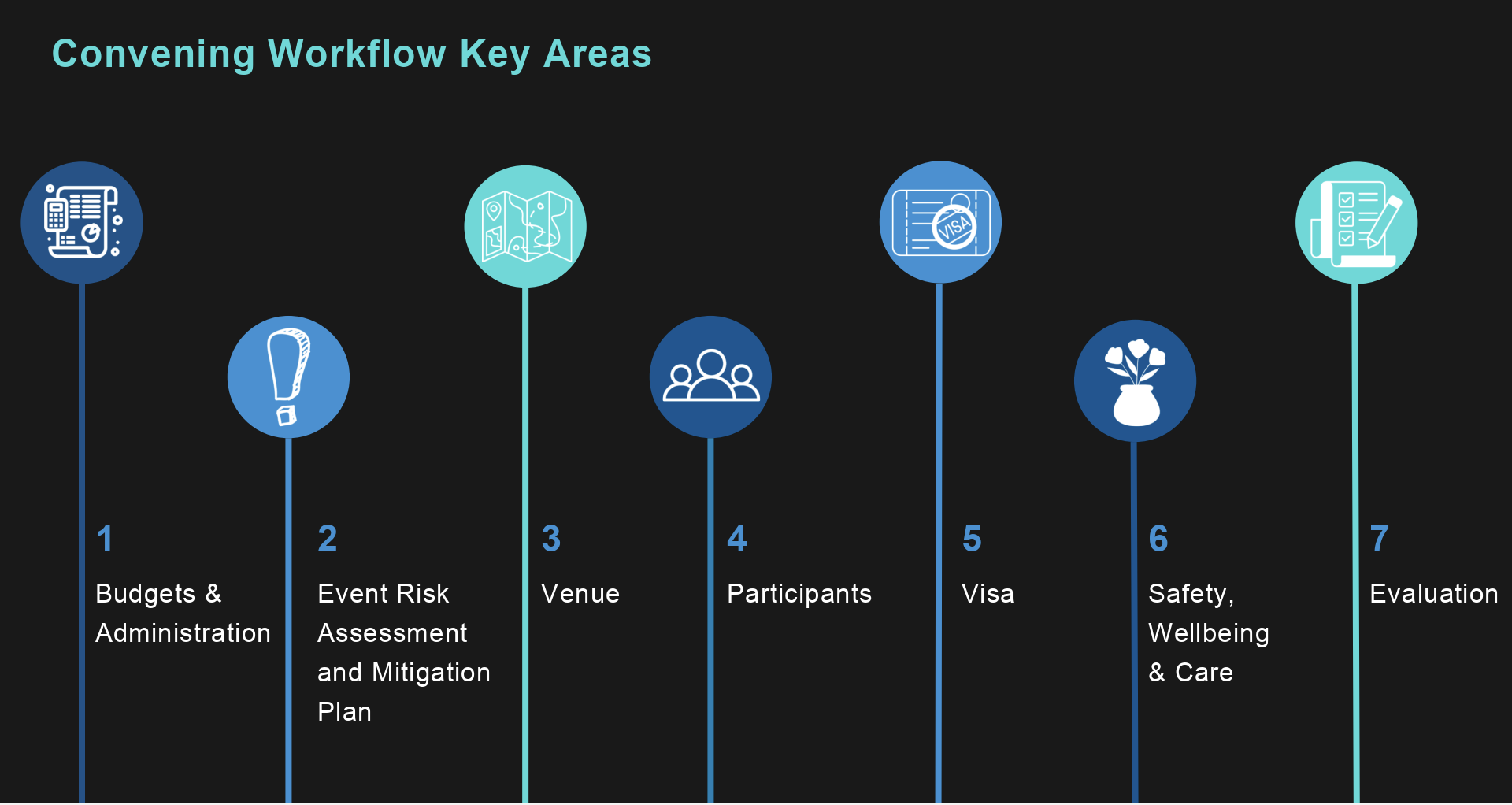
The manual, part of APC’s Policies, Systems and Procedures (PS&P) framework, is structured in sections that cover the full convening cycle, right from its idea inceptions all the way to the final evaluation, report, and financial reconciliation. In this first iteration, the sections on Programme and schedule, Communication strategy, and MEL are just introduced and limited to the operations aspects.
The manual is meant to provide a step-by-step guide to hold convenings, with clear and easy references to all relevant policies and detailed explanation and representation of workflow and procedures.
It is structured in three larger chapters: Introduction, Convening cycle and Relevant policies.
The Introduction explains the purpose as well as the structure of the manual.
OPS (people and systems) key links & repositories provides a direct access to all APC convening links and repositories as well as policies that are mentioned and referenced throughout the manual and constitutes the institutional administrative, financial and operational foundation for all APC staff.
Convening cycle represents the body of the manual that explains and guides the complex actions the convening team needs to take in the given time.
Planning together introduces APC convening guiding principles, approach, consolidated practices and embedded care elements woven throughout the cycle that will organically give life to the convening experience of all the actors involved.
Roles involved in convening cycle is self-explanatory, defining and explaining all the different roles involved, their responsibility, and interdependence to create clarity and place accountability.
Convening timeline addresses the impact on the overall planning timeline, depending on features such as types of convening: hybrid, online and in-person, or any variable around participants such as their number, profiles, or ways of identifying and selecting them: open call, nomination, pre-registration, pre-defined.
Budget and finance clarifies assumptions, decisions, costs and financial resources necessary for a convening to happen and explains the tools and instruments the convening team has at its disposal to collaborate and organise information in an effective, transparent, safe, agreed and structured way.
Location and venue selection describes the process to identify and decide locations where hybrid and in-person convening will happen, provide examples and indication of the timeline, clarify the roles each of the convening team member has in the finalisation of the decisions, and the criteria and relevance regarding the decision.
Convening risk assessment provides guidelines for the identification and description of a contextualised risk assessment of both external and internal risks and possible responses measures, explains the decision-making process, including how to collect inputs and how to share and communicate the result to the larger group of participants.
Participants’ information and communication focuses on the way information is collected and shared with participants, channels and ways of communication from one-on- one to collective, who is responsible for what type of communication, and ways of internal coordination among the members of the convening team.
Visa explains APC’s approach to visas for convenings led or co-led by APC as well as for those organised by other entities such as governments and international organisations. It addresses financial resources necessary to ensure visa support, explains existing types of visas, and APC’s processes to identify the best one. It stipulates both the process and the actual procedures of preparing visa-supporting documentation and provides templates. It also describes the various roles and staff involved in the process.
International and local travel explains all the elements related to international and local travel, procurement procedures apropos of flights bookings. It addresses all administrative procedures, templates, roles and coordination necessary to provide support and assistance to all participants.
Safety, well-being and care explains how APC embeds these three as a foundational element of the convening cycle. It provides references and how-tos for Policies on Harassment and APC’s Principles of Participation. It also provides logistics advisory standards and explains how to prepare one, and includes and curates the dissemination of the safety and security measures that emerge from the risk assessment process.
Monitoring, evaluation and learning (MEL) describes APC’s processes, procedures and roles for MEL within the convening cycle, organically addresses the programmatic and operations’ learning, creating a baseline and a closing evaluation moment. It shares tools and templates that effectively support the inclusion of MEL within the convening cycle.
In this very first edition of the manual, not all sections will be addressed or curated in depth since they entail a longer process of distillation. The Ops core team has focused its efforts to consolidate existing workflows, procedures and templates, and prioritises providing a unique source and an easy consultation space outside of share2 to best support convening coordination teams.
The manual has a yearly iteration planned to ensure its relevance and consistency with APC policies and practices; the Ops core team plans to address less developed sections in the next cycle, based on wider consultation with other teams.
No comments to display
No comments to display